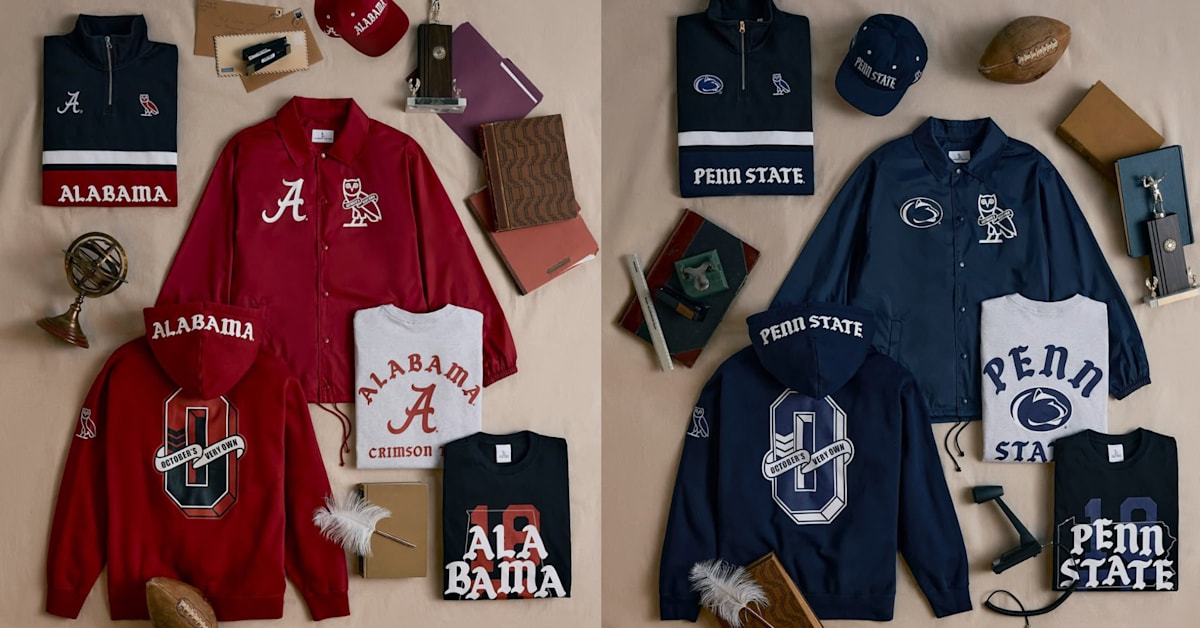
The first headline told us who bought what. The filing shows how OVO is actually split.
When Authentic Brands Group announced its OVO deal in August, the basic structure was clear: Authentic took a majority position in the brand’s intellectual property, Drake kept a meaningful stake and creative role, and Vince Holding Corp. took the operating business.
The SEC filing adds the part that makes this a real Booth to Boardroom deal.
OVO now sits in two different buckets:
the intellectual property, which is owned through a new IP entity, and
the operating business, which runs stores, e-commerce, wholesale and day-to-day apparel execution.
Those pieces no longer sit in the same place.
That matters because “who owns OVO?” now has more than one answer.
The IP company is 51% Authentic, 44% Drake and 5% Vince
Vince’s filed transaction materials say Authentic formed a new subsidiary to hold OVO’s intellectual property.
The ownership is:
- 51% Authentic Brands Group
- 44% Drake
- 5% Vince Holding Corp.
That means Drake did not sell the entire brand and disappear.
He also did not keep control of the IP company.
Authentic owns the majority. Drake still owns a very large minority position. Vince has a smaller equity interest.
This is more specific than the original public announcement, which described Drake only as retaining a “significant” stake.
The SEC paperwork gives the exact percentages.
Vince bought the operating business separately
At the same time, Vince acquired OVO’s operating companies.
That includes the business infrastructure around the brand:
- retail stores
- e-commerce
- wholesale relationships
- operating assets and liabilities
- the existing OVO team
Vince says OVO had 12 stores across Canada, the United States and the United Kingdom when the transaction closed.
The team remains based in Toronto.
So Authentic did not simply buy a clothing company and begin running every store.
The structure separates the thing being owned and licensed from the company doing the selling and operating.
This is the mechanic that makes the whole structure easier to understand.
Vince owns OVO’s operating business.
But the operating business does not own most of the OVO intellectual property.
Instead, Vince entered into a long-term license agreement giving it the exclusive right to use OVO IP for licensed apparel.
In exchange, Vince pays a royalty.
So the basic loop is:
IP entity owns the brand rights → Vince runs the apparel business → Vince pays to license those rights.
That is a very different structure from one company owning the logo, stores, e-commerce, wholesale and product operation all in the same box.
What Vince paid — and what the filings actually disclose
The SEC filing discloses one exact purchase-price number.
Vince paid $6 million for its 5% interest in the OVO IP entity.
That number should not be turned into a made-up estimate of what Drake personally received or what every percentage point of the company is worth.
Private transaction terms can include different rights, different consideration and other economics that do not reduce cleanly to one multiplication problem.
What we can say is what the filing says:
Vince bought 5% of the new IP entity for $6 million.
The companies have not publicly disclosed a clean total “Drake payout” figure.
The filings do not provide one.
Vince’s later quarterly update adds another unusual detail.
The company says it acquired the OVO operating business for a nominal cash purchase after a portion of the proceeds from the IP transaction was used to strengthen the operating company’s balance sheet.
That does not mean the stores, e-commerce operation or wholesale relationships had no value.
It means the transaction was structured in a way where the IP sale and the operating-business transfer were connected, and the public-company filing describes the cash paid for the operating business itself as nominal.
A headline “sale price” can mean very different things depending on which asset in the structure you are talking about.
Vince’s September quarterly update says OVO generated nearly $50 million in calendar-year 2025 sales.
That is company-reported operating performance, not an estimate of Drake’s personal income.
Vince also says it sees a path to more than $100 million in OVO sales by fiscal 2030, with adjusted EBITDA margins in the low double digits.
That is a forward-looking company target, not a guaranteed outcome.
Still, it explains what Vince thinks it bought.
This is not only a famous logo.
It is an existing retail business that Vince believes can become materially larger through more stores, stronger e-commerce, wholesale expansion and shared infrastructure.
Drake kept a major stake without keeping the operating job
This may be the most interesting part of the deal for artists.
Drake still owns 44% of the OVO IP entity.
But Vince is the company responsible for the operating business.
Authentic is the majority IP owner and brand-management partner.
That means Drake’s retained ownership is concentrated in the OVO IP entity rather than the retail operating company. He does not need to personally run stores, manage inventory, build wholesale systems or operate e-commerce infrastructure to keep meaningful equity in the brand rights.
His continuing role can stay closer to the founder-side assets the company says he will keep shaping:
the brand identity, cultural meaning and creative direction connected to OVO.
The partners take on more of the machinery required to scale the commercial side.
Artist ownership conversations often collapse into two choices:
own everything forever, or sell everything and lose control.
Real deals are usually more complicated.
A founder can sell part of an asset.
A founder can keep meaningful equity.
A different company can run operations.
An IP company can collect royalties.
A licensing partner can use the brand in defined categories.
Creative involvement can continue even after majority ownership changes.
OVO now shows all of those ideas in one transaction.
The risk is that the operator can grow the business without protecting the culture
The structure looks efficient on paper.
That does not mean it automatically works.
OVO became valuable because it felt connected to a specific world: Drake, Toronto, music, fashion, scarcity, collaborations and a recognizable visual identity.
If the new operating system expands too aggressively, over-licenses the owl or turns OVO into a generic mall brand, the same scale that increases sales could weaken the thing people originally cared about.
That is why the companies keep emphasizing separate creative teams and Drake’s continued involvement.
The next chapter is not only whether OVO gets bigger.
It is whether it gets bigger without becoming less OVO.
The Booth to Boardroom takeaway
Drake’s OVO deal is useful because it shows that a brand can be broken into different business functions.
You can own the intellectual property.
Someone else can operate the stores.
A license can connect the two.
A founder can keep equity without keeping every operational responsibility.
That does not make the structure automatically good.
It makes the questions more precise.
When an artist builds something beyond music, ask:
What is the actual asset?
The name?
The trademark?
The products?
The customer list?
The stores?
The creative direction?
The operating company?
The distribution relationships?
Then ask who owns each piece, who gets paid from each piece and who is responsible for making each piece work.
OVO is no longer one simple company story.
That is exactly why the deal is worth studying.