
Dreamville existed before J. Cole had a major-label deal
Dreamville makes more sense when you stop treating it like something J. Cole created after he became famous.
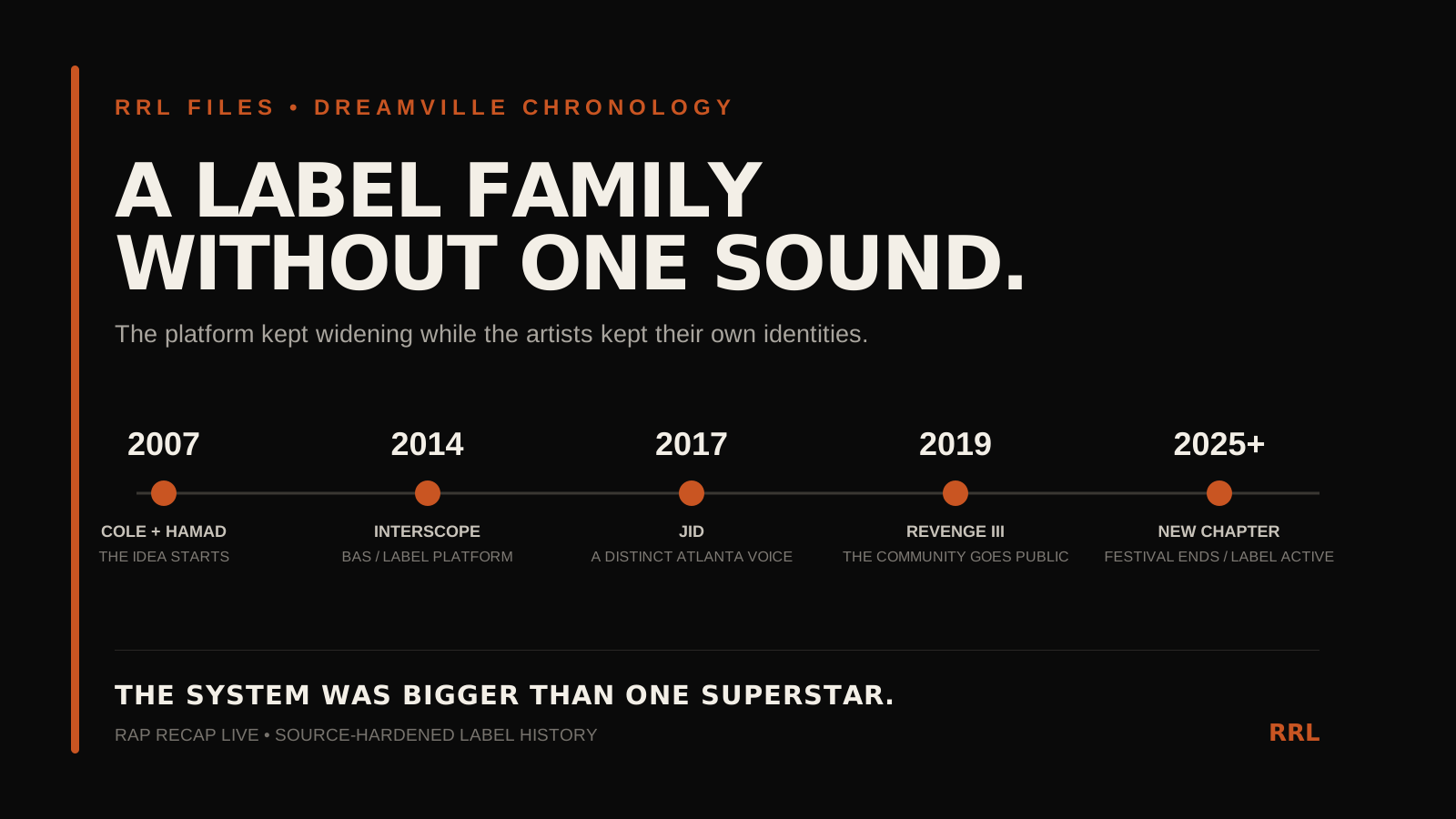
Cole and Ibrahim Hamad started the idea in 2007, years before Cole became Roc Nation's first artist signing. Hamad later remembered the beginning as almost literal: a house full of friends deciding, “This will be Dreamville.” There was not a finished company, a deep roster or a major-label machine behind it yet. It was a name for the world they wanted to build around the music.
That order matters. Dreamville was not a celebrity vanity label added after the success. The idea grew alongside Cole's own career.
2014 turned the idea into a formal label platform
The major structural shift came in January 2014.
Interscope announced an exclusive label relationship with Dreamville and identified Cole and Hamad as the partners who had launched it in 2007. The announcement also introduced Bas as the first artist signing under the newly formalized Interscope-backed structure.
That gave Dreamville something it did not have in the earliest years: major-label distribution and support that could be used for careers other than Cole's.
But the more important question was what Dreamville would do with that support.
A lot of artist-founded labels become extensions of the founder. The new artists are expected to borrow the star's sound, image or audience. Dreamville gradually built a different identity.
The roster worked because the artists did not sound like one another
Bas could live in one lane. Cozz could live in another. Ari Lennox brought R&B into the family. JID arrived from East Atlanta with a technical, elastic rap style that did not sound like a copy of Cole. EarthGang carried another Atlanta branch with its own history inside Spillage Village.
JID's 2017 signing is one of the clearest examples of the model working.
He already had an Atlanta identity and relationships before Dreamville. Signing did not require erasing that foundation. The Never Story gave a wider audience a clearer entry point into an artist who already had a point of view.
That distinction became part of Dreamville's real brand: the common thread was not one sound. It was trust in the people being selected.
Hamad has repeatedly described the job in similar terms—understanding that every artist needs a different blueprint rather than forcing Cole's path onto the entire roster.
Revenge of the Dreamers III made the label feel like a community
Dreamville's biggest culture-building moment may not have been a solo album at all.
In January 2019, the label gathered artists and producers at Tree Sound Studios in Atlanta for the sessions that became Revenge of the Dreamers III. Invitations spread publicly, artists from outside the roster came through, and the recording process itself became part of the story.
That changed how people could experience the label.
Dreamville was no longer only a logo attached to separate releases. The sessions made the relationships visible. Cole, JID, Bas, EarthGang and outside collaborators could exist in the same creative room without every record needing to orbit around the founder.
The finished album was nominated for Best Rap Album at the 2020 Grammys, while “Down Bad” earned a Best Rap Performance nomination.
The bigger achievement was cultural: Dreamville turned collaboration into a public event before the project even arrived.
Dreamville Fest took the idea off the records
The festival pushed the same idea into the physical world.
After the planned 2018 launch was disrupted by Hurricane Florence, Dreamville Festival debuted in Raleigh in 2019. Over its run, the event mixed Dreamville artists with major guests while turning North Carolina into a recurring gathering point for the fan community around the brand.
The fifth edition in April 2025 was announced as the final Dreamville Festival in that form.
Ending the festival did not mean the label disappeared. It marked the end of one specific expression of the Dreamville idea.
The current chapter is more complicated than one roster list
Dreamville's 2025–2026 picture should not be flattened into the peak-era roster.
Artists' situations changed over time, and not every release now moves through the same structure. A peak-era roster list is not a 2026 contract map.
What can be verified is that the Dreamville label remained active after the festival chapter closed. JID's 2025 album God Does Like Ugly carries Dreamville/Interscope credits, and the project earned JID 2026 Grammy nominations including Best Rap Album.
That makes Dreamville's current story less about recreating 2019 and more about what parts of the system survive when the founder's career, individual artist deals and the festival all move into new phases.
What Dreamville actually built
Dreamville's strongest asset was never simply access to J. Cole.
Cole gave the company gravity. Hamad helped turn that gravity into a real label operation. But the label became meaningful because listeners could care about JID, Bas, EarthGang and other artists for reasons that were not dependent on sounding like the founder.
That is a harder thing to build than a recognizable logo.
It requires the audience to trust the curation, the artists to keep their own identities, and the company to accept that development will not look the same for everybody.
Dreamville's story is therefore less about cloning a superstar and more about converting one artist's taste, relationships and leverage into a platform where multiple careers could become real.
That is why it belongs in the RRL Rap Tree as more than a J. Cole footnote.