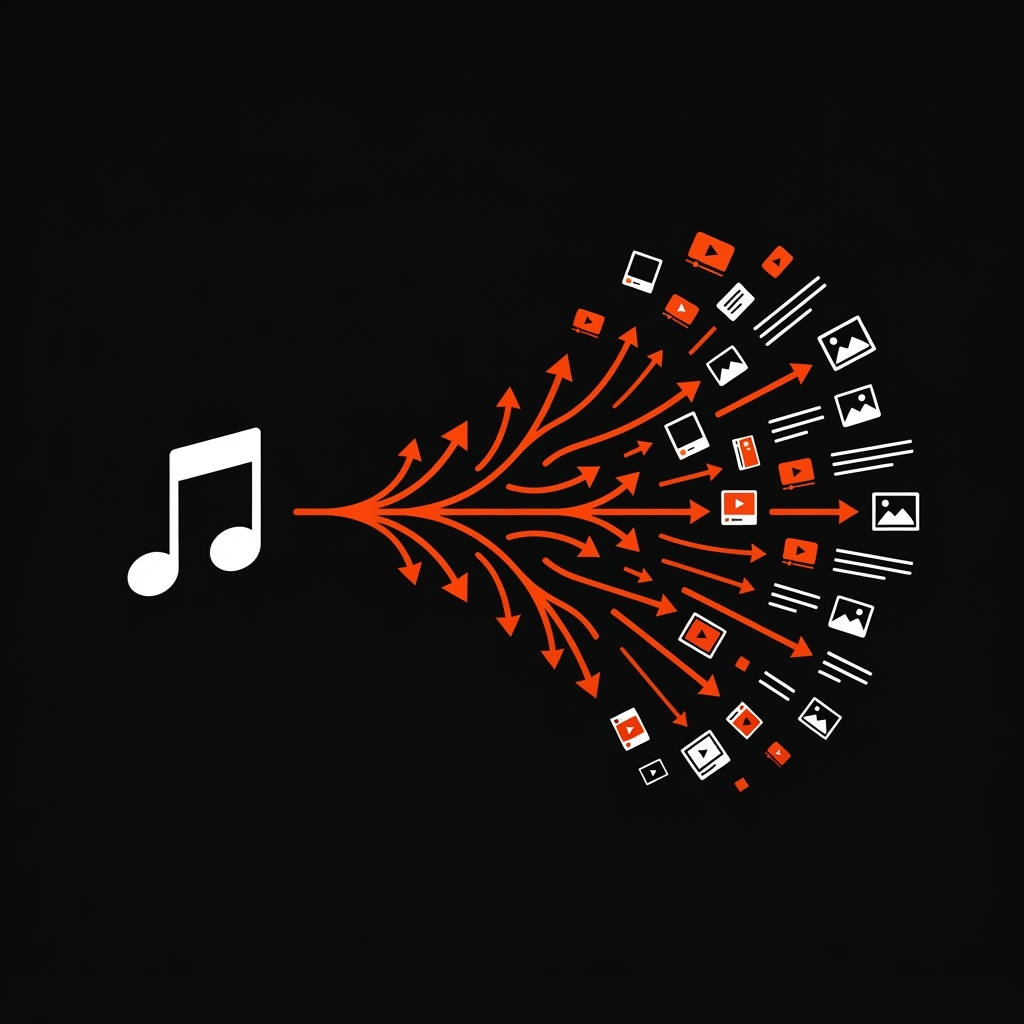
You probably do not need 30 brand-new ideas.
You need to stop treating every piece of content like it has to come from a different creative universe.
You already spent time writing the song, recording it, choosing the beat, shaping the hook, arguing over the mix, shooting visuals and living whatever made the record worth writing.
There is content inside all of that.
The old version of this guide promised that every song contains exactly “30+ pieces” and even claimed artists were leaving 90% of their content on the table.
That is neat marketing math. It is not how creativity works.
Some songs may give you ten strong pieces. Some may give you fifty. Some need almost no explanation because the mystery is part of the appeal.
The better principle is:
get more mileage out of the real story around the song before inventing random posts just to stay active.
Start with the song itself
Before you make a calendar, ask what is actually interesting here.
- Is there a bar people will quote?
- Is the hook instantly performable?
- Did something happen in the studio?
- Is there a real story behind the record?
- Did the producer make an unusual choice?
- Is the visual world strong?
- Does the song connect to a city, relationship, moment or problem your audience already understands?
Those answers tell you what content deserves to exist.
Six content buckets you can pull from one release
These are not quotas. Use the ones that fit the record.
1. Performance
Let people hear the music in different contexts.
- clean performance clip
- car performance
- live-show moment
- rehearsal footage
- stripped-down or acoustic version
- mic performance
- one-take verse
The point is not to fake variety. It is to let the same record hit differently depending on how it is experienced.
2. Story
Tell people what makes the song mean something.
- what happened before you wrote it
- the line that started the record
- what the hook actually means
- who you were talking to
- what almost got cut
- why the record sounds different from your last one
Do not explain every lyric. Leave some room for the audience.
3. Process
Show enough of the making to make the finished result feel richer.
- studio clip
- producer building the beat
- raw vocal versus final vocal
- cover-art process
- video treatment references
- rehearsal
- mix changes
Process content works best when something is actually happening—not when somebody pretends to turn a knob for the camera.
4. Visual world
Your release already has colors, clothes, locations, artwork and imagery around it.
Use that world consistently:
- photo selects
- alternate cover crops
- short visualizer
- lyric moment
- behind-the-scenes photo dump
- mood-board references where appropriate
The goal is recognition.
Someone should be able to see a piece before reading your name and feel like it belongs to the same era.
5. Conversation
Give fans something to respond to that is actually connected to the music.
- which verse hits harder?
- what line did you catch first?
- should the alternate version drop?
- fan reaction or interpretation
- creator remix or performance response
Do not ask engagement-bait questions nobody cares about.
If the answer does not teach you anything or create a real conversation, skip it.
6. Proof and momentum
As the release moves, new material appears:
- live crowd reaction
- playlist or media placement worth mentioning
- creator use
- fan videos
- milestone with real context
- collaborator response
- show footage
This is how the campaign keeps growing without you pretending release day is still happening three weeks later.
Capture more while you are already creating
The cheapest content is often footage you remember to capture while the real work is happening.
During one studio session, get:
- a clean vertical shot of the performance
- a wide shot
- the producer working
- a short explanation of the idea
- a few still photos
- room sound or raw vocals if useful
During a video shoot, get:
- finished-scene clips
- setup footage
- wardrobe/details
- location texture
- a quick director or artist thought
At a show, get:
- entrance
- strongest crowd moment
- close performance angle
- fan reactions
- merch or line footage
You are not creating fake behind-the-scenes. You are documenting work that was already happening.
Do not post the same clip fifteen times with a new caption
Repurposing does not mean lazily duplicating.
One performance can become:
- a 10-second hook on Reels
- a slightly longer version on TikTok
- a Short with a different opening line
- a Story with a poll
- a still frame for a Community post
But each platform and audience may need a different entry point.
The asset is shared. The packaging changes.
Build around phases, not a rigid six-week calendar
Every release moves differently.
Think in three loose phases.
Before the drop
Create curiosity.
Show enough story, performance, personality or visual world that the release has meaning before the link arrives.
When it drops
Make the song easy to find.
Put your strongest performance and story content near the release while attention is concentrated.
After the drop
Follow the evidence.
If one line becomes the conversation, build around it.
If fans love the second verse more than the hook, use the second verse.
If a live version starts outperforming everything, lean into the live version.
Do not keep forcing the calendar you wrote a month ago while the audience is telling you what they care about now.
The biggest mistake: creating content that has no connection to why people like the music
You can post every day and still weaken the artist if none of the content reinforces:
- identity
- music
- story
- personality
- visual world
- community
Volume is not the goal.
Recognition and return are.
Five strong pieces that make somebody understand the record can do more for the artist than thirty filler posts that make the page look busy.
A simple planning sheet
Before your next release, make five columns:
Asset — what do we already have?
Story — what is worth saying?
Format — performance, process, visual, conversation, proof?
Platform — where does this version make the most sense?
Purpose — discovery, deeper connection, release reminder, fan participation?
Then shoot what is missing while you are already in production.
That is a content system without turning the artist into a factory.
The RRL take
One song does not owe you exactly 30 posts.
But one good song usually gives you more to work with than “cover art + link in bio.”
Document the process. Pull out the story. Build a recognizable visual world. Perform the record in different ways. Follow what fans respond to.
Get more out of the music you already made before demanding another idea from yourself tomorrow morning.